


Example Avuncular DNA Test Results
Understanding Aunt and Uncle DNA Test Results
Avuncular DNA testing is used to determine whether two individuals share a biological aunt/uncle and niece/nephew relationship.
Unlike paternity DNA testing, which can generally provide a highly conclusive inclusion or exclusion, avuncular testing is probability-based. Results are calculated using a statistical value known as the Avuncular Index (AI), which measures how strongly the genetic evidence supports the proposed biological relationship.
If you are considering an Aunt and Uncle DNA Test, reviewing example results can help you understand what your report will contain and how to interpret the findings.
How an Avuncular DNA Test Works
An avuncular DNA test compares genetic markers between a child and the alleged biological aunt or uncle.
Each person inherits half of their DNA from their mother and half from their father. Because full biological siblings share approximately 50% of their DNA on average, their children are expected to share approximately 25% of their autosomal DNA with a full biological aunt or uncle.
Our accredited laboratory partners analyze 23 or more genetic markers and calculate an Avuncular Index to evaluate the proposed relationship.
The index is used to calculate a probability of relationship based on the genetic evidence and the statistical assumptions used in the analysis.
The laboratory follows validated testing and quality-control procedures to verify results before releasing the final report.
Types of Avuncular DNA Tests: Full vs. Half Aunt or Uncle
There are two main biological relationships that may be evaluated.
Full Aunt or Uncle DNA Test
A full biological aunt or uncle shares both biological parents with the child's mother or father.
A full aunt or uncle and niece or nephew share approximately 25% of their autosomal DNA on average.
The laboratory compares their genetic markers to determine whether the evidence supports the proposed relationship.
Half Aunt or Uncle DNA Test
A half biological aunt or uncle shares only one biological parent with the child's mother or father.
A half aunt or uncle and niece or nephew share approximately 12.5% of their autosomal DNA on average.
Because these relationships have different expected levels of genetic sharing, it is important to identify whether the proposed relationship involves a full or half aunt or uncle before testing.
The Three Possible Avuncular DNA Test Results
An Avuncular DNA Test can produce three general outcomes:
Relationship Is Supported (Positive Result)
Relationship Is Not Supported (Negative Result)
Inconclusive Result
These outcomes are based on the calculated Avuncular Index and the corresponding probability of relationship.
As a general statistical guide:
Avuncular Index greater than 1.0: The genetic evidence favors the proposed relationship.
Avuncular Index less than 1.0: The genetic evidence favors the alternative hypothesis.
Avuncular Index near 1.0: The evidence provides little support for either conclusion.
An index of 1.0 represents equal statistical support for the two hypotheses being compared. A value above or below 1.0 does not, by itself, guarantee a conclusive result.
Let's review each outcome.
Example 1: Relationship Is Supported (Positive Result)
When the tested individuals share genetic markers consistent with the proposed biological relationship, the report may conclude that the relationship is supported.
An Avuncular Index greater than 1.0 indicates that the observed genetic evidence is more likely under the proposed aunt/uncle relationship than under the alternative hypothesis.
The higher the index, the stronger the statistical support.
Your report will generally include:
The calculated Avuncular Index
The Probability of Relationship
A conclusion describing whether the proposed relationship is supported
What This Means
A positive avuncular result indicates that the DNA evidence supports the proposed biological aunt/uncle relationship.
However, because avuncular testing is an indirect relationship test, it does not provide the same degree of certainty as a direct paternity DNA test.
The strength of the conclusion depends on the calculated index, the probability, and the individuals included in the analysis.
Example 2: Relationship Is Not Supported (Negative Result)
When the genetic evidence is more consistent with the individuals not having the proposed avuncular relationship, the report may conclude that the relationship is not supported.
An Avuncular Index less than 1.0 indicates that the observed genetic evidence favors the alternative hypothesis.
The lower the index, the stronger the statistical evidence against the proposed relationship.
What This Means
A negative avuncular result indicates that the available genetic evidence does not support the proposed biological relationship.
However, a negative result should be interpreted in the context of the complete report. An index only slightly below 1.0 provides relatively weak evidence and may not be sufficient for a definitive conclusion.
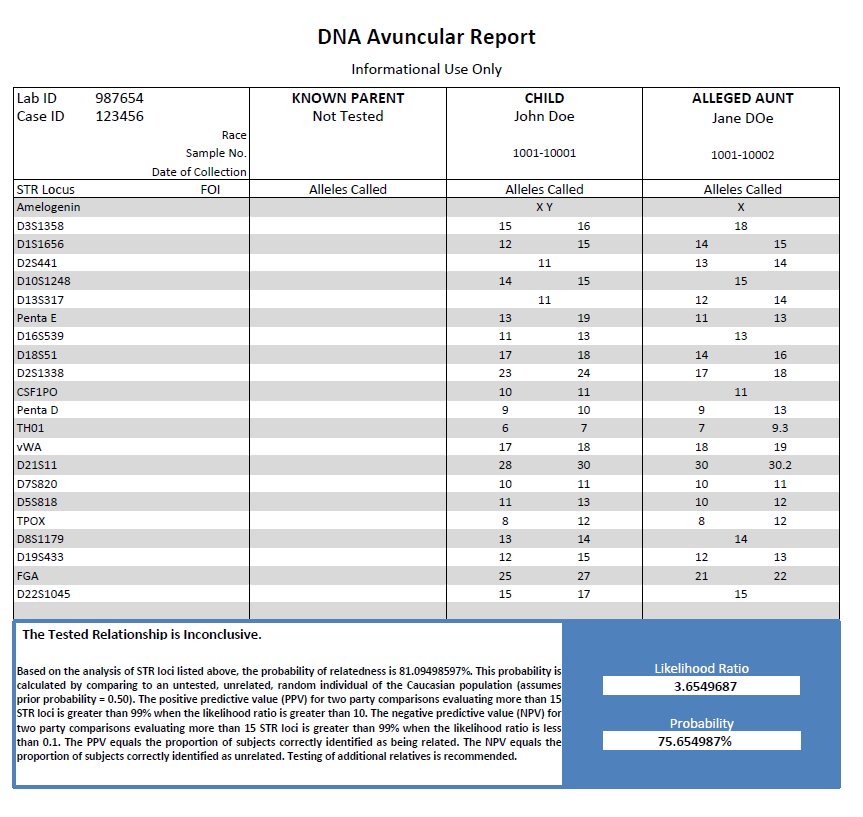
Example 3: Inconclusive Avuncular DNA Test Result
Sometimes the tested individuals share genetic markers that could be consistent with either the proposed relationship or the alternative hypothesis.
When the Avuncular Index is near 1.0, the available evidence may not be strong enough to support or reject the relationship confidently.
What This Means
An inconclusive result does not establish whether the individuals are biologically related.
It means that the genetic evidence is insufficient to distinguish confidently between the relationships being evaluated.
This can occur even when the samples contain sufficient DNA and the laboratory successfully completes the analysis.
How to Improve an Inconclusive Avuncular DNA Test
If an avuncular test produces inconclusive results, additional family members may help strengthen the analysis.
Depending on the family structure, useful participants may include:
The child's biological mother: Particularly when testing a paternal aunt or uncle, the mother's DNA can help identify which genetic markers the child inherited maternally.
Another biological aunt or uncle: An additional relative from the same family may provide more genetic information.
A biological grandparent: Testing a parent of the alleged aunt or uncle may help evaluate the proposed family relationship.
Including additional relatives may increase or decrease the calculated Avuncular Index and provide a clearer statistical conclusion.
However, additional testing does not guarantee a conclusive result.
Why Avuncular DNA Tests Are Probability-Based
Avuncular testing is more complex than direct paternity testing because aunts, uncles, nieces, and nephews share only a portion of their inherited DNA.
A full aunt or uncle shares approximately 25% of their autosomal DNA with a niece or nephew on average, while a half aunt or uncle shares approximately 12.5%.
Actual genetic sharing varies because DNA is inherited through a random process.
The laboratory uses statistical calculations to determine how likely the observed genetic markers would be under the proposed biological relationship compared with an alternative relationship hypothesis.
This produces the Avuncular Index and the corresponding probability of relationship.
It is also important to understand that an avuncular test evaluates the proposed family relationship. It does not necessarily identify which specific sibling of the tested aunt or uncle is the child's biological parent.
For additional information, read our guide: What Is Avuncular DNA Testing?.
Why Our Avuncular DNA Test Results Are Reliable
At DNA Test Answers, we understand that relationship DNA testing often involves important personal and family questions.
Our accredited laboratory partners use validated DNA analysis methods, established statistical calculations, and laboratory quality-control procedures to produce reliable results.
Each report provides the genetic findings and statistical interpretation needed to understand whether the proposed relationship is supported.
Because avuncular testing is probability-based, we also recognize the importance of explaining inconclusive results and identifying when additional family members may improve the analysis.
Have Questions About Your Avuncular DNA Test Results?
Understanding the Avuncular Index and probability of relationship can sometimes be confusing.
Our knowledgeable DNA testing specialists can help explain your results, discuss the significance of the reported findings, and identify whether additional testing may be beneficial.
Whether you're considering a Home Aunt and Uncle DNA Test or a Forensic Avuncular DNA Test, we're available to help you understand your testing options.



Still not sure which test you need?
Our knowledgeable DNA experts will listen to your unique situation and advise the best testing option for you.
Reach out to our DNA experts for any help with your situation
Client Reviews
Home Paternity DNA Test includes:
Easy to follow instructions
Sterile buccal collection swabs per person
Sample envelopes for each person involved
Consent form
Prepaid return label to our laboratory. (USA Only)
Select from test options below: